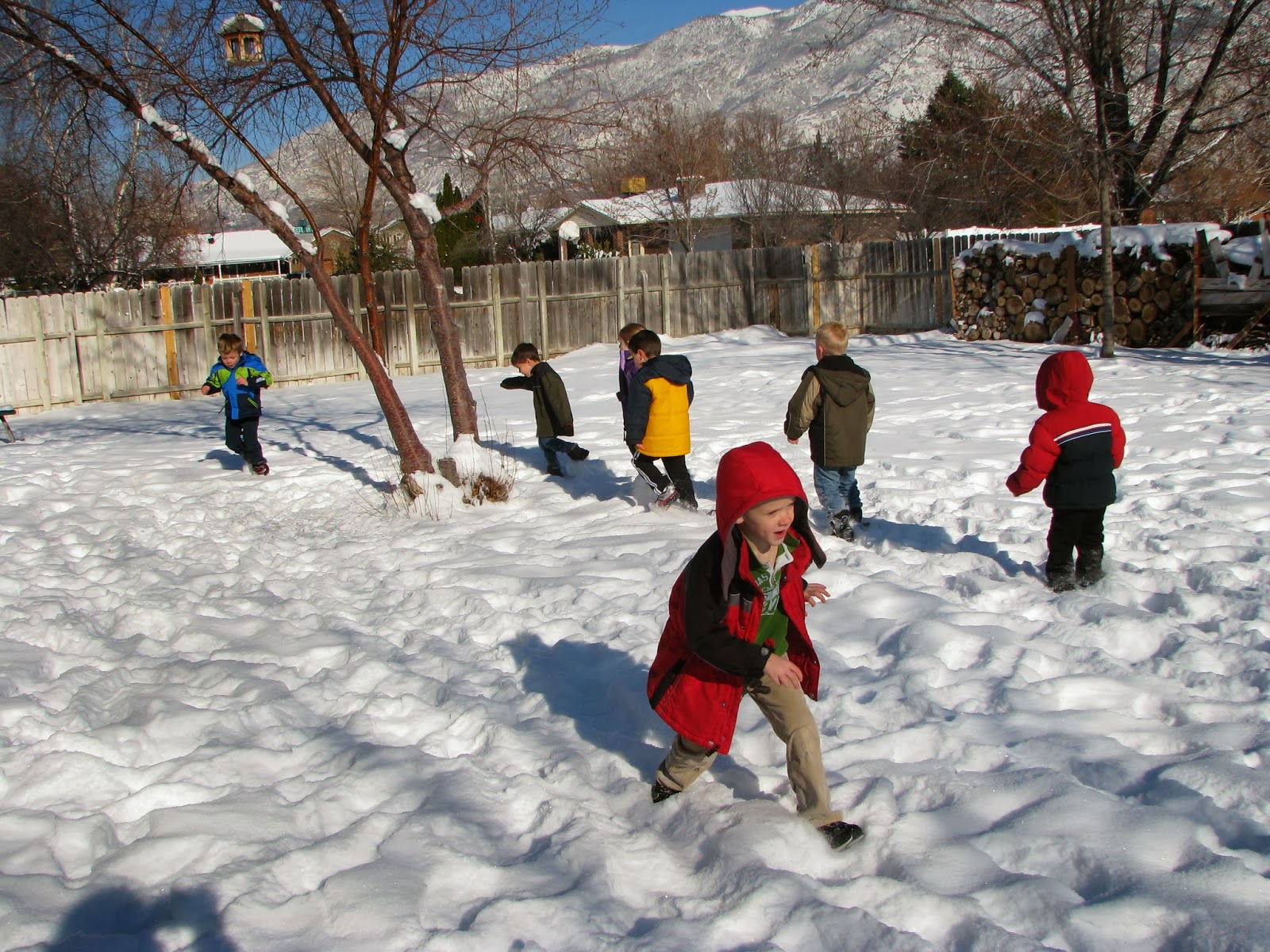
Winter has arrived and the children are loving the snow. We had a winter storm that brought us nine inches in one day! It's been cold. We check our thermometer every day to read the temperature. If it's above 20 degrees we go outside to exercise AND play!
The children have been making observations about the snow. They noticed that the snow sparkles in the sunlight, snow can be soft or crunchy, snow can sometimes stick when you roll it (and sometimes not), icicles form on the roof top, and shadows are long in winter.
The children also went to the garden to search for their buried pumpkins.
Our study topic for December was weather, and more specifically snow. We began our weather study by making snowmen in a bag and building a weather station.
The making of the snowmen in a bag was first an exercise in cooperation.
And second an exercise in watching and waiting for the snowmen to melt. The children like to check the bags each day they go outside.
Finally, the snowmen did melt on the day before Christmas.
When the children came back from winter break they were excited to discover that their snowmen had (almost magically) turned into ice!
The children are now thinking about what caused this change to happen. Their hypothesis is the sunlight did it. I think we'll need to test that hypothesis. Is it really light that changes snow to ice?
To learn more about snow we read the book
Snowflake Bentley, which is a true story about the life of snow scientist Wilson Bentley (1865-1931). He left an extraordinary gift to the world--a book of snowflake photos that was 50 years in the making! After reading this picture book, we looked through Bentley's original publication to examine his gorgeous photos.
Bentley's snowflake photos very much inspired the children in their play. Children created snowflakes out of various building materials in the classroom, including our magnet blocks and pegs.
Here the children are looking at Bentley's photos to create snowflakes.
The snowflakes got more elaborate over time.
The following week I also added jingle bells to the building area. The bells stick to the magnet blocks and this inspired even more creativity. (See the Santa house above.)
This boy particularly enjoyed creating snowflakes. He did this work every school day for two weeks. I love the look of satisfaction on his face here as he creates.
And this was his masterpiece. Beautiful, isn't it? I was really pleased with this work.
When I put pegs in the building center, this boy discovered he could make snowflakes out of pegs as well.
And one day after indoor exercise, one of the girls suggested we make a human snowflake. I thought that was a fabulous idea! So did the kids! They negotiated how to best do this. When they were satisfied with their arrangement, the kids asked me to take a photo of their human snowflake. So I did. (I love this photo.)
The children began to notice that all snowflakes are different, but there is something that is the same about them. Snowflakes have hexagons inside them! Hexagons have six sides and snowflakes have six points. Many children wrote about this in their science journals.
We are still curious how snowflakes form in the sky. We are also curious how meteorologists predict when it's going to snow. We want to keep thinking about this. Snow is cool science!
The social emotional skill we talked about this month was hard work and determination. Snowflake Bentley didn't give up. He was determined to find a way to take pictures of snowflakes. After many failures, he finally had success. The children learned that with practice and determination they can do hard things too.
We learned we could do hard things when we practiced cutting snowflakes from paper (i.e., coffee filters). The children were told they would have many failures before they finally had success. I was watching to see who would not give up, and who would keep trying until they got a snowflake they were pleased with.
One little boy was VERY determined. He cut snowflakes for probably an hour. Above is a photo of the various snowflakes he made in sequence. You can see his "failures" here and finally his "success".
When the children had a snowflake they were satisfied with, they glued it to blue paper and added glitter. Even after this snowflake was glued, this boy wanted to see if he could do better and better. He continued practicing until he had mastered the skill, and every snowflake he made was a beautiful, unique work of art. This was a great moment for him.
Winter also brought illness to our school. Unfortunately, we had at least three children miss school days this month. We are glad they are feeling better now. Our missing students prompted a doctor office dramatic play.
This girl brought her baby in for a check-up. The "doctor" examined the baby, measured it, and listened to its heart. The "computer guy" asked if the baby had any allergies and took an x-ray of the baby. And finally the doctor gave the baby some medicine. Then the mother decided she wanted to be the doctor. She found a baby that was very sick and about to die and helped save the baby.
Then the phone rang and the doctor said the hospital was closed. They decided the hospital was closed because they needed to decorate for Christmas. The children began drawing Christmas pictures on the white board.
I observed this play from across the room and recorded the conversation. Here is the dialogue verbatim:
E: My baby needs a check-up.
B: Ok, does your baby have any problems?
E: Yes. She's sick. She needs some medicine.
B: (He measures the baby and listens to her heart then gives her some medicine.)
Z: Does your baby have allergies? Is is allergic to cats or dogs?
E: No.
Z: What kind of blood pressure do they have?
E: This is the problem. They ate too much fish and too much bread.
Z: Ok. I'll check our calendar.
B: How much are you going to pay me? (E gives B some money.)
E: Now I want to work at the hospital. Are these your babies?
Z: No. I'm the computer guy.
E: Well, these babies are about to die. We need to check them.
B: Okay, they need an x-ray.
Z: (He gives the baby an x-ray.)
E: (She gives the baby some medicine.)
E: Here. Someone's calling you. (She hands B the phone.)
B: Hi. Is somebody sick? Sorry, we're closed.
E: We need to decorate the hospital for Christmas.
B: Ok.
(They start drawing pictures on the white board.)
This kind of play is right on! I love it! The children are taking on roles, negotiating what's going to happen in the play scenario, practicing new vocabulary, and building friendships. So great.
For math this month we worked on making patterns and rote counting. We practiced making patterns by stringing colored beads on pipe cleaners to make candy canes.
These made beautiful ornaments for our Christmas tree.
We used the leftover beads to decorate foam trees and gingerbread cookies in the water table.
The children also enjoyed searching for snowflakes and jingle bells and filling test tubes with these items to make "snow globes".
We practiced rote counting by playing an estimation game at circle. I had several estimation jars. Children tried to guess how many items were in each jar, then we counted to see how close we were.
We also made a Christmas counting book. On the last page, children got to create their own word problem.
For example, one child dictated "How many marshmallows are in my hot chocolate?" I wrote down the word problem he invented. Then he drew a cup of hot cocoa with 20 marshmallows in it and wrote the number 20.
About half the children are working on counting accurately to 20 or 30. The other half are working on counting to 100. A couple children counted to 100 for the first time this month, almost independently! That was exciting for them.
This accomplishment came after working with our hundred chart, adding 100 reindeer "noses".
I also had a work with a "magic wand" that picked up colored chips by magnetism from the hundred chart.
Another popular math work this month was counting jingle bells. Children put the numbered sticks in order, then added the correct number of jingle bells to each stick.
Parents, if you'd like to give your child more practice with counting (and writing) numbers to 30, you can purchase a calendar that kids make themselves. Once a month they write the numbers and draw a picture. They sell blank calendars like this at Lakeshore Learning for about $2.00. If you're interested, I can pick one up for you next time I'm there.

We played a game similar to Don't Eat Pete where students try to find a snowflake hidden under one of the mittens. Students call out letters and try to win more cards than teacher.
The children really enjoy this game. Different groups of children played this game with each other many times over the past few weeks. They took turns being the "teacher" (the person who gets to hide the snowflake).
The children also used the mittens from this game to create their own alphabet mitten.
Below is our snow box. This Montessori-inspired work invited children to practice writing the letters we were focusing on this month.
At our school we learn letters by comparing them to each other. We don't have a letter of the day or a letter of the week. Rather we have about 8 or 9 letters that we focus on for a month. Here this girl is writing the letters of the month in the snow box. It's really just salt. But it's fun to write with a candy cane. :)
Another literacy skill we started thinking about this month was how to tell a story. After reading a book together, we describe what happened in the beginning, middle, and end of the story. This is preparation for children dictating their own stories. Here we thought about a story we were familiar with, then drew what happened in the beginning, middle, and end of the story.
An art lesson this month extended our thinking from last month about color mixing. One boy had mixed what he called "pine needle" green in his test tube.
So we experimented to see how we might make pine needle green with tempura paints. We discovered we could make many shades of green by mixing green with different amounts of white or black paint.
I showed the children how to do this at circle time. Then they mixed their own shades of green and used the paint to create. This boy used the colors he mixed to paint a zebra.
I next invited the children to make evergreen trees using the different shades of green we created. I challenged the children to create a large triangle by using many small circles (TP tube stamps).
I love the look of exuberance on this girl's face as she stamps her paper with color.
Here are the Christmas trees the children created. Very festive!
I used this Montessori-inspired work to assess children's ability to differentiate between different shades of color.
Finally, on the last day of school before winter break we read
The Polar Express and celebrated by having a pajama day and making hot chocolate.
The kids were fascinated by how the marshmallows and candy cane "melted" or "disappeared" in the hot cocoa. So when we returned to school after the break, we investigated what dissolves and what doesn't dissolve.
We tested sugar, salt, marshmallows, candy canes, oil, flour, and oats. All the ingredients listed on our hot cocoa box. We also tested some green sand, just for fun.
We made some predictions before we started adding ingredients to the water. We weren't always right but we learned something with each experiment we tried. Now we need to think about the best way to tell others about the results of our experiment. We'll see who can come up with a good chart for their science journal!
Parents, if any of you have a learning experience you'd like to share with the children you are more than welcome to share your expertise with us. I strongly encourage parents to visit the school and be a part of our learning community. Say the word, and we will arrange for you to come!
I hope you all had a wonderful holiday season. I am looking forward to a productive new year of learning and discovery. Best wishes for a happy new year!
Teacher April